Sending iMessage Mini-App Payloads from macOS
I have been super excited by the stuff the guys at Photon have been doing with iMessages. They kind of nerd-sniped me with their launch letting you programmatically send custom mini-apps.
Basically, they let you send arbitrary web content via their helper iMessage app extension. I believe they also support sending custom payloads for any iMessage mini-app. Their helper app extension Spectrum makes it so you don't need to worry about needing to setup your own app extension, instead you just need to send the web payload.
These notes are just to scratch my own reverse-engineering itch to figure out how Photon/Spectrum works. I would not use this for production — just use their API and services. While editing this post, I noticed Linq has also launched a similar service.
tl;dr The interesting part is inside Messages.app's private ChatKit stack:
MSMessage
  -> CKBrowserItemPayload / IMPluginPayload
  -> CKComposition
  -> IMMessage
  -> CKConversation sendMessage:onService:newComposition:
If you also want their default Jump Jump preview image, you pass a hidden CKIMFileTransfer as the shelfMediaObject. That produces a normal delivered iMessage app payload row plus a hidden JPEG attachment in chat.db.
REing Spectrum
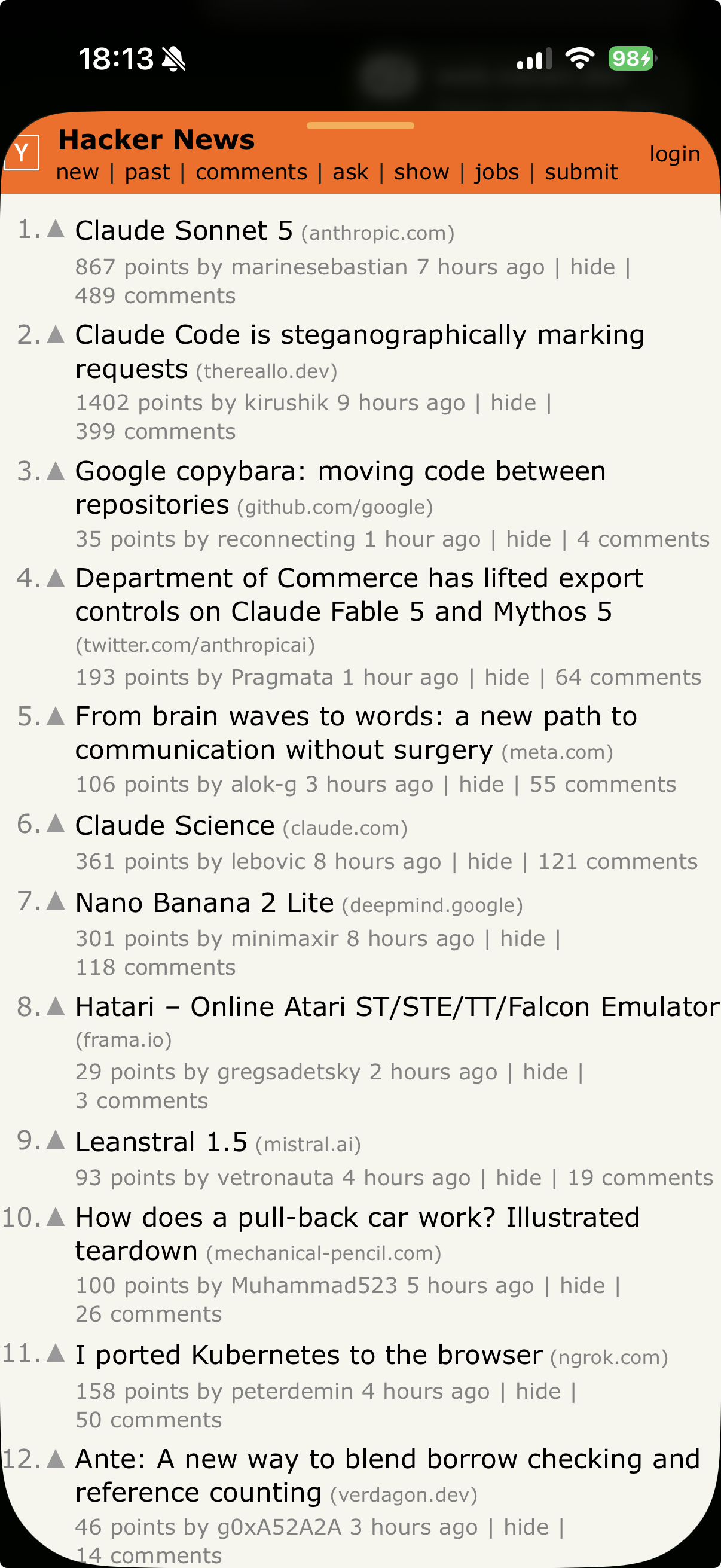
After I got my hands on the unencrypted version of their iMessages app extension, I unpacked it to check whether there were any magic entitlements or backend services involved. Spectrum is simply an iOS 26 message payload provider.
The extension Info.plist has:
NSExtensionPointIdentifier = com.apple.message-payload-provider
CFBundleIdentifier = codes.photon.Spectrum.MessagesExtension
The host app is basically a shell:
CFBundleIdentifier = codes.photon.Spectrum
LSApplicationLaunchProhibited = true
The extension links public Apple frameworks:
/System/Library/Frameworks/Messages.framework/Messages
/System/Library/Frameworks/WebKit.framework/WebKit
/System/Library/Frameworks/UIKit.framework/UIKit
/System/Library/Frameworks/Foundation.framework/Foundation
The imported Objective-C classes include:
MSMessagesAppViewController
MSMessage
MSMessageTemplateLayout
WKWebView
WKWebViewConfiguration
NSURLSession
UIGraphicsImageRenderer
UIImage
Nothing out of the ordinary. I'm not sure what Apple's policy is on WebKit views inside iMessage extensions, but Spectrum got approved on the App Store, so presumably it's fine.
The IPA also contains MiniApps.json with the Jump Jump game being a default app that is available from the start:
{
  "featured": [
    {
      "id": "jump-jump",
      "url": "https://jump-jump-production.up.railway.app/",
      "fallbackTitle": "Jump Jump",
      "fallbackSubtitle": "A mobile web recreation of the Jump Jump charge-and-land loop."
    }
  ]
}
I did not see a Photon backend URL or obvious allowlist in the strings. The bundled app list is just a local default.
The most useful strings in the extension binary were:
metadata request failed url=%{public}s error=%{public}s
manifest request failed url=%{public}s error=%{public}s
failed to decode web app manifest url=%{public}s error=%{public}s
failed to write Open Graph preview media error=%{public}s
failed to write generated preview media error=%{public}s
og:image:url
og:image
twitter:image
og:title
twitter:title
og:description
description
webp
WEBP
So the model is roughly:
- The message carries a URL and template layout data.
- Spectrum fetches metadata, Open Graph tags, and maybe a web app manifest.
- It writes/generates preview media for the message.
- When opened, the selected message is rendered by Spectrum's
WKWebView.
That means the "web access" is not coming from iMessage transport. It is coming from the installed message payload provider extension. iMessage delivers the plugin payload. Spectrum receives it and uses WebKit.
What the delivered row looks like
The good row had the same shape as a real mini-app send from iPhone:
is_sent = 1
is_delivered = 1
error = 0
text = NULL
balloon_bundle_id = com.apple.messages.MSMessageExtensionBalloonPlugin:P8XT6232SL:codes.photon.Spectrum.MessagesExtension
payload_data = NSKeyedArchiver bplist
cache_has_attachments = 1
part_count = 2
The hidden preview image appears as an attachment:
transfer_state = 5
hide_attachment = 1
mime_type = image/jpeg
uti = public.jpeg
The payload itself is an archived dictionary with keys like:
URL
ai
appid
layoutClass
an
userInfo
Where:
URLis the web URL to open in the iMessage app surface.aiis app/preview image data.appidis the App Store adam id.anis the app name.layoutClassis usuallyMSMessageTemplateLayout.userInfocarries caption/subcaption fields.
For Spectrum/Photon, the bundle id I observed was:
com.apple.messages.MSMessageExtensionBalloonPlugin:P8XT6232SL:codes.photon.Spectrum.MessagesExtension
The snippet
This is the core LLDB script shape. This lets us attach to Messages.app, create an MSMessage, turn it into a private plugin payload, wrap that in a CKComposition, optionally attach a hidden preview image, and then send through the existing CKConversation.
Replace:
RECIPIENTTARGET_URLPREVIEW_JPEGAPP_BUNDLE_IDAPP_NAMEAPP_ADAM_ID
expr -l objc++ -O -- ({
  id list = ((id(*)(Class,SEL))objc_msgSend)(
    (Class)objc_getClass("CKConversationList"),
    @selector(sharedConversationList)
  );

  id conv = ((id(*)(id,SEL,id))objc_msgSend)(
    list,
    @selector(conversationForExistingChatWithChatIdentifier:),
    @"RECIPIENT"
  );

  id svc = ((id(*)(id,SEL))objc_msgSend)(
    conv,
    @selector(sendingService)
  );

  id targetURL = ((id(*)(Class,SEL,id))objc_msgSend)(
    (Class)objc_getClass("NSURL"),
    @selector(URLWithString:),
    @"TARGET_URL"
  );

  id previewURL = ((id(*)(Class,SEL,id))objc_msgSend)(
    (Class)objc_getClass("NSURL"),
    @selector(fileURLWithPath:),
    @"PREVIEW_JPEG"
  );

  id transfer = ((id(*)(id,SEL,id,id,id,id,id,bool,bool))objc_msgSend)(
    (id)((id(*)(Class,SEL))objc_msgSend)(
      (Class)objc_getClass("CKIMFileTransfer"),
      @selector(alloc)
    ),
    @selector(initWithFileURL:transcoderUserInfo:attributionInfo:adaptiveImageGlyphContentIdentifier:adaptiveImageGlyphContentDescription:hideAttachment:isScreenshot:),
    previewURL,
    nil,
    nil,
    nil,
    nil,
    true,
    false
  );

  id imageData = ((id(*)(Class,SEL,id))objc_msgSend)(
    (Class)objc_getClass("NSData"),
    @selector(dataWithContentsOfFile:),
    @"PREVIEW_JPEG"
  );

  id layout = ((id(*)(id,SEL))objc_msgSend)(
    (id)((id(*)(Class,SEL))objc_msgSend)(
      (Class)objc_getClass("MSMessageTemplateLayout"),
      @selector(alloc)
    ),
    @selector(init)
  );

  ((void(*)(id,SEL,id))objc_msgSend)(layout, @selector(setCaption:), @"TITLE");
  ((void(*)(id,SEL,id))objc_msgSend)(layout, @selector(setImageTitle:), @"TITLE");
  ((void(*)(id,SEL,id))objc_msgSend)(layout, @selector(setSubcaption:), @"SUBTITLE");
  ((void(*)(id,SEL,id))objc_msgSend)(layout, @selector(setMediaFileURL:), previewURL);
  ((void(*)(id,SEL,id))objc_msgSend)(layout, @selector(setMediaData:), imageData);

  id ms = ((id(*)(id,SEL))objc_msgSend)(
    (id)((id(*)(Class,SEL))objc_msgSend)(
      (Class)objc_getClass("MSMessage"),
      @selector(alloc)
    ),
    @selector(init)
  );

  ((void(*)(id,SEL,id))objc_msgSend)(ms, @selector(setURL:), targetURL);
  ((void(*)(id,SEL,id))objc_msgSend)(ms, @selector(setLayout:), layout);

  id adam = ((id(*)(Class,SEL,long long))objc_msgSend)(
    (Class)objc_getClass("NSNumber"),
    @selector(numberWithLongLong:),
    APP_ADAM_ID
  );

  id pluginPayload = ((id(*)(id,SEL,id,id,id,bool))objc_msgSend)(
    ms,
    @selector(_pluginPayloadWithAppIconData:appName:adamID:allowDataPayloads:),
    imageData,
    @"APP_NAME",
    adam,
    true
  );

  ((void(*)(id,SEL,id))objc_msgSend)(
    pluginPayload,
    @selector(setPluginBundleID:),
    @"APP_BUNDLE_ID"
  );

  id comp = ((id(*)(id,SEL,id,id,id,id))objc_msgSend)(
    (id)((id(*)(Class,SEL))objc_msgSend)(
      (Class)objc_getClass("CKComposition"),
      @selector(alloc)
    ),
    @selector(initWithText:subject:shelfPluginPayload:shelfMediaObject:),
    nil,
    nil,
    pluginPayload,
    transfer
  );

  id messages = ((id(*)(id,SEL,id,id))objc_msgSend)(
    comp,
    @selector(messagesFromCompositionFirstGUIDForMessage:sendingService:),
    nil,
    svc
  );

  id msg = ((id(*)(id,SEL,unsigned long))objc_msgSend)(
    messages,
    @selector(objectAtIndex:),
    0UL
  );

  ((void(*)(id,SEL,id,id,bool))objc_msgSend)(
    conv,
    @selector(sendMessage:onService:newComposition:),
    msg,
    svc,
    true
  );

  msg;
})

detach
quit
Run it like this:
lldb -b -p "$(pgrep -x Messages | head -1)" -s send-miniapp.lldb
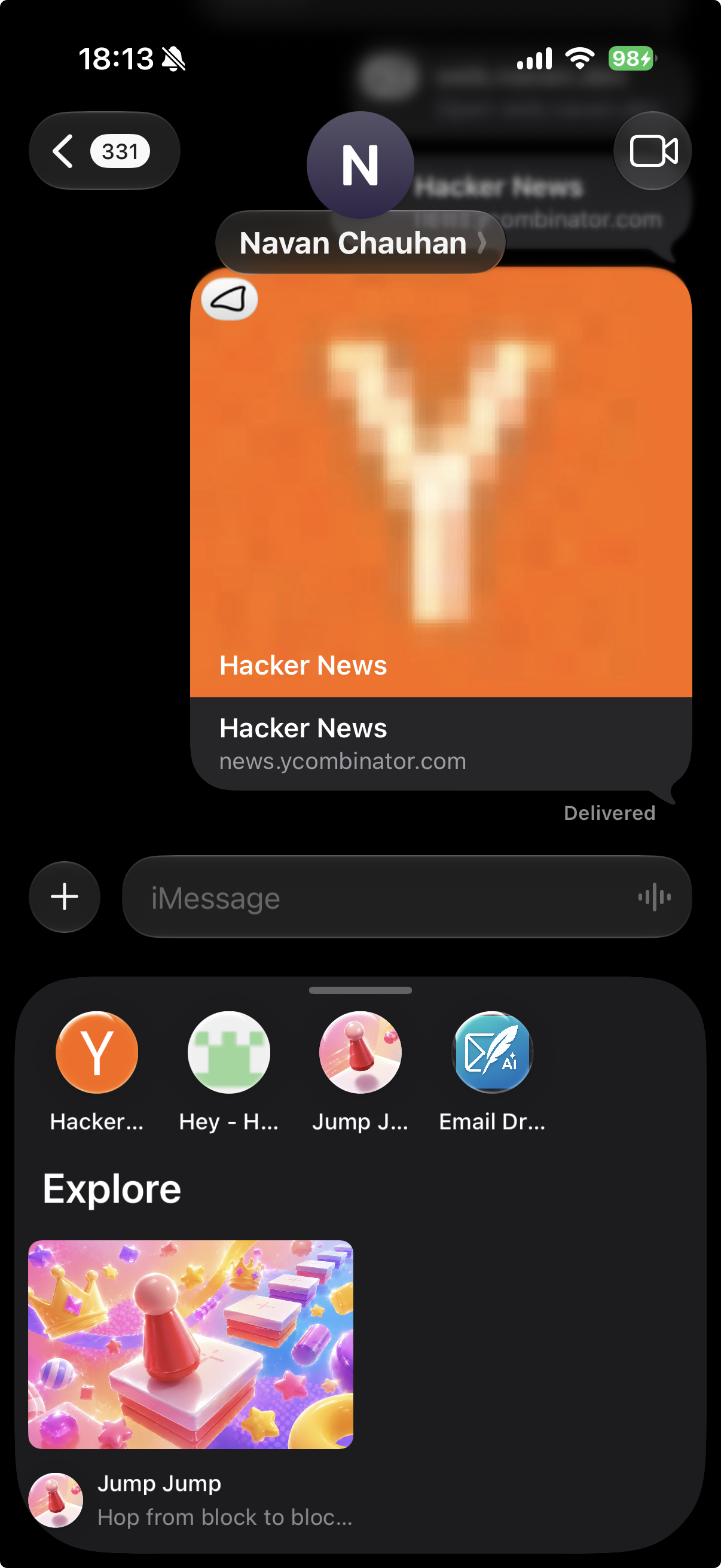
Spectrum payload for Hacker News
Using HN for my examples has kind of become a hello-world ritual at this point.
I decided to use HN's logo as the hidden preview attachment.
curl -LfsS https://news.ycombinator.com/y18.svg -o /tmp/hn-y18.svg
sips -s format jpeg /tmp/hn-y18.svg --out "$HOME/Library/Containers/com.apple.MobileSMS/Data/tmp/hn-y18-preview.jpeg"
sips -z 512 512 "$HOME/Library/Containers/com.apple.MobileSMS/Data/tmp/hn-y18-preview.jpeg" \
  --out "$HOME/Library/Containers/com.apple.MobileSMS/Data/tmp/hn-og-preview.jpeg"
Then use:
TARGET_URL = https://news.ycombinator.com/
PREVIEW_JPEG = /Users/me/Library/Containers/com.apple.MobileSMS/Data/tmp/hn-og-preview.jpeg
TITLE = Hacker News
SUBTITLE = news.ycombinator.com
APP_NAME = Spectrum
APP_ADAM_ID = 6777616651LL
APP_BUNDLE_ID = com.apple.messages.MSMessageExtensionBalloonPlugin:P8XT6232SL:codes.photon.Spectrum.MessagesExtension
The delivered row had:
cache_has_attachments = 1
is_delivered = 1
hide_attachment = 1
payload URL = https://news.ycombinator.com/
Why the obvious approaches did not work
AppleScript can send text and files, but it does not expose the plugin payload surface.
Directly inserting into chat.db gives you local artifacts, not an actual delivered iMessage — the imagent/IDS daemon state has to agree with what's in the database.
Patching the transport dictionary too late can get the IDS send to happen, but Messages may persist the local row as a normal image/file message instead of a plugin payload.
The reliable path was letting ChatKit build the message:
MSMessage
  -> private plugin payload
  -> CKComposition with shelfPluginPayload and shelfMediaObject
  -> messagesFromCompositionFirstGUIDForMessage:sendingService:
  -> sendMessage:onService:newComposition:
Debugging queries
Useful chat.db checks:
sqlite3 "$HOME/Library/Messages/chat.db" "
SELECT
  m.ROWID,
  datetime((m.date/1000000000)+978307200,'unixepoch','localtime'),
  quote(m.text),
  m.balloon_bundle_id,
  length(m.payload_data),
  m.is_sent,
  m.is_delivered,
  m.error,
  m.guid,
  m.cache_has_attachments,
  length(m.attributedBody),
  length(m.message_summary_info),
  m.part_count
FROM message m
JOIN chat_message_join cmj ON cmj.message_id = m.ROWID
JOIN chat c ON c.ROWID = cmj.chat_id
WHERE c.chat_identifier = 'RECIPIENT'
ORDER BY m.ROWID DESC
LIMIT 10;
"
Dump the payload:
sqlite3 "$HOME/Library/Messages/chat.db" "
SELECT writefile('/tmp/payload.bplist', payload_data)
FROM message
WHERE ROWID = MESSAGE_ROWID;
"

plutil -p /tmp/payload.bplist
Check the hidden attachment:
sqlite3 -header -line "$HOME/Library/Messages/chat.db" "
SELECT *
FROM attachment
WHERE ROWID IN (
  SELECT attachment_id
  FROM message_attachment_join
  WHERE message_id = MESSAGE_ROWID
);
"
Notes
This needs a local Messages process with your account already signed in, and SIP needs to be disabled.
The important conceptual bit is that iMessage mini-app sends are normal IMMessages with a balloon bundle id and plugin payload, and ChatKit already knows how to produce them if you feed it the right private objects.